


Best Air Coolers for Dubai Summer 2026 — What to Look For and What Actually Works
An honest buyer's guide to air coolers for Dubai's conditions — the specs that matter, the spaces they suit, and how to avoid the most common and expensive mistakes.
Every summer the same conversation happens across warehouses, factory floors, event venues, and family homes across Dubai. The electricity bill from running AC everywhere is unsustainable, the space is too large or too open for traditional air conditioning to work properly, and someone suggests looking into air coolers. Then comes the overwhelming part — the market is flooded with options ranging from cheap plastic units that barely move air to serious industrial machines built for continuous operation in extreme heat.
This guide cuts through that. Not a list of products with recycled spec sheets — an honest breakdown of what actually matters when choosing an air cooler for Dubai's specific conditions in 2026, and what different setups genuinely need.
First — Does an Air Cooler Actually Work in Dubai?
This question comes up constantly and deserves a straight answer. Yes — with an important qualifier.
Air coolers work through evaporative cooling — warm air passes through water-saturated pads, loses heat through evaporation, and comes out cooler on the other side. The efficiency of this process depends significantly on ambient humidity. The drier the air, the more effective the evaporation, and the greater the temperature drop.
Dubai's summer has two distinct phases that change the calculation:
The other critical factor is ventilation. Air coolers need airflow — an open window, a door, a ventilation point — to work properly. In a sealed, recirculating environment, humidity from the cooler's own evaporation builds up and progressively reduces effectiveness. In a well-ventilated space, this isn't an issue and the cooler performs consistently.
For warehouses, workshops, factories, construction sites, outdoor events, and homes with good airflow — air coolers are highly effective for the majority of the Dubai summer. For sealed apartments with no ventilation options, pairing a cooler with a dehumidifier or a portable AC unit gives better results than relying on either solution alone.
What to Actually Look For — The Specs That Matter
Most buyers focus on the wrong numbers. Here's what genuinely matters for Dubai conditions:
Different Spaces, Different Requirements
The right air cooler varies considerably depending on where it's going. Here's the honest breakdown by environment:
Maintenance Through the Season — What Most People Skip
An air cooler bought in May and not maintained will perform noticeably worse by August. The cooling pads accumulate mineral deposits from the water, reducing airflow and cooling efficiency. The water tank and internal components develop scale buildup that the pump has to work against. Filters clog with the dust that Dubai air carries in abundance.
- Monthly pad cleaning — flush mineral buildup and check pad condition
- Regular water tank flushing — prevent scale and bacterial buildup inside the reservoir
- Filter checks — Dubai's ambient dust loads filters faster than most climates
- Pump inspection — listen for changes in pump sound that indicate blockage or wear
Well-maintained units at the end of a Dubai summer perform close to how they did at the start. Neglected units are half as effective and twice as likely to need replacement before the next season.
Why 2026 Is a Good Time to Upgrade
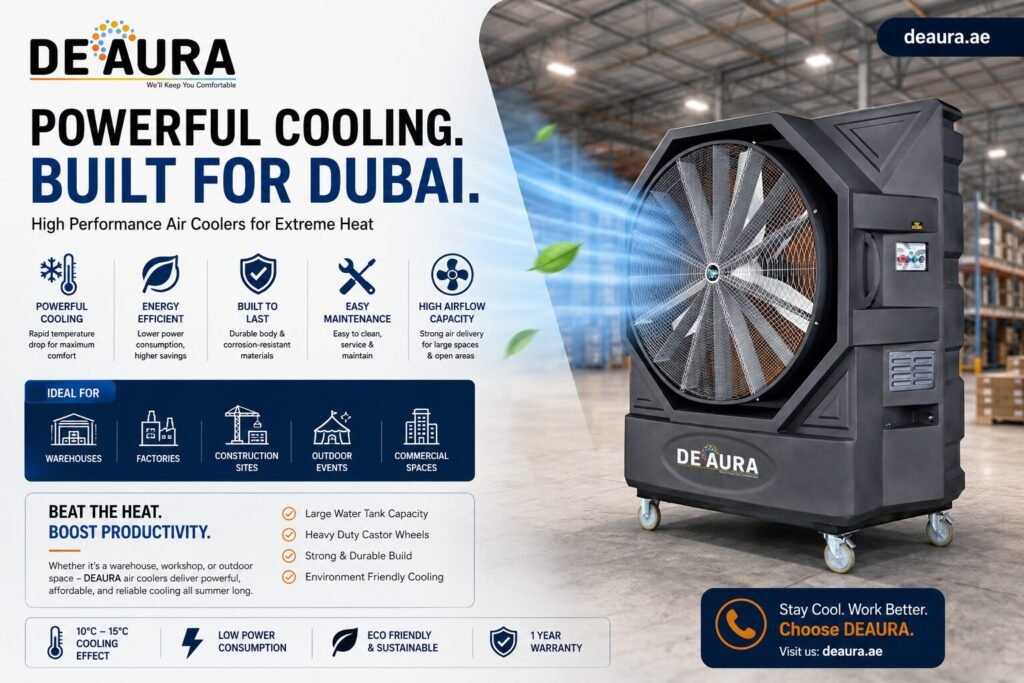
The air cooler market has matured significantly in the UAE over the past few years. Early commercial units were often residential products dressed up in larger housings. The current generation of industrial air coolers available in the UAE — including those supplied by specialists like DEAURA — are purpose-built for the demands of commercial and industrial operation in extreme heat.
Better motors, better pad materials, genuinely portable designs, and build quality that lasts multiple seasons rather than one. If you're running equipment bought two or three summers ago, the performance difference with current commercial-grade units is noticeable — and the operating cost difference over a full season is meaningful. Browse the full DEAURA cooling range to compare what's available across residential, commercial, and industrial grades — or if an event or temporary project is coming up, the air cooler rental catalogue is a faster route to the right equipment without the upfront investment.
The Bottom Line
The best air cooler for Dubai summer 2026 is the one correctly sized for your space, built to run continuously in extreme heat, and properly maintained through the season. Buying on price alone is a false economy in a climate that tests equipment harder than almost anywhere else.
Match the unit to the environment. Invest in commercial-grade equipment if the application is commercial. Maintain it monthly. And pair it with proper airflow management — HVLS fans for air distribution, misting fans for outdoor spots — and you have a cooling setup that works through even the worst of what a Dubai summer delivers.
Explore DEAURA Air Coolers