


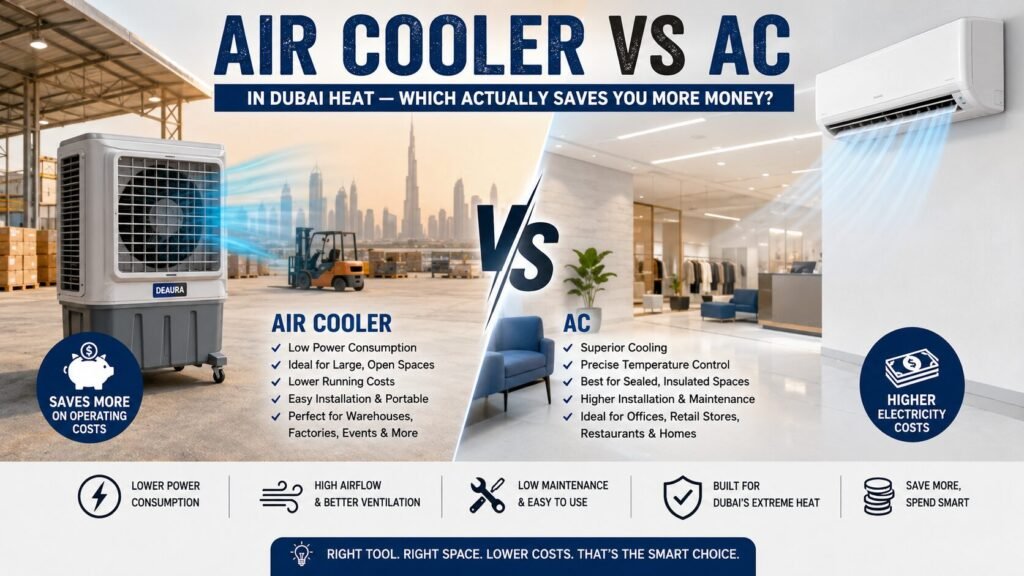
Air Cooler vs AC in Dubai Heat — Which Actually Saves You More Money?
A practical breakdown for UAE warehouses, offices, factories, events and commercial spaces — without the marketing fluff.
Let's be honest — nobody in Dubai is questioning whether they need cooling. That argument ended somewhere around May. The real question businesses and homeowners are asking is: how much is this going to cost me, and am I throwing money at the wrong solution?
The air cooler vs. AC debate has been going on for years, but most comparisons are written for temperate climates where summers are mild and electricity bills are an afterthought. Dubai is not that place.
Here, your cooling choices directly affect your monthly expenses, your staff's productivity, and sometimes your bottom line. Whether you're looking at commercial air coolers or investing in a full AC setup, the decision deserves a proper breakdown — so let's do that.
The Electricity Bill Problem
A standard split AC unit in Dubai typically draws anywhere between 1.5 to 3.5 kilowatts per hour depending on its capacity. Run it for 10 hours a day through the summer — which is conservative for most commercial setups — and you're looking at serious consumption.
DEWA rates in the UAE use a tiered slab system, and once you cross the lower slabs, the cost per unit climbs. For businesses running multiple AC units across a large floor, this stacks up fast.
Even the most powerful industrial air coolers use only a fraction of the electricity consumed by a single AC unit — making them the smarter pick for large, ventilated spaces.
For warehouse operators, event companies, or businesses running equipment in large open spaces, this difference isn't small — it's the difference between a manageable summer and one that quietly bleeds cash.
But Wait — AC Cools Better, Right?
Yes, and that matters. This isn't a piece telling you air coolers are magical and AC is outdated.
Air conditioning uses refrigerant-based technology to actively remove heat from a space and recirculate cooled, dehumidified air. In a sealed, insulated room — an office, hotel lobby, or retail store — it is genuinely superior. For spaces where humidity control also matters, pairing AC with a dehumidifier can deliver even tighter climate control. If you need a mobile AC solution, portable AC units offer flexibility without permanent installation.
Air coolers work through evaporative cooling: warm air passes through water-saturated pads and comes out cooler on the other side. This works exceptionally well when there's airflow — doors, windows, and ventilation points. In a properly ventilated space, a good air cooler can reduce the ambient temperature by 10 to 15 degrees Celsius while moving large volumes of air.
The right tool depends entirely on the space. Forcing an air cooler into a sealed showroom is a bad idea. Running traditional AC across a 5,000-square-foot warehouse is an expensive one.
The Spaces Where Air Coolers Win — Decisively
Dubai's economy runs on logistics, construction, manufacturing, and events. A massive portion of the workforce spends time in warehouses, on worksites, in factories, or at outdoor venues.
These are environments where:
- Spaces are too large for AC to be cost-effective
- Doors remain open due to constant movement of people and goods
- Cooling semi-open areas with AC wastes huge amounts of energy
- Every operational dirham matters
For these environments, air coolers aren't a compromise — they're the correct solution. A single industrial air cooler can cover large areas, runs continuously in extreme temperatures, and costs far less to operate compared to conventional air conditioning systems. In very large facilities, combining air coolers with HVLS fans creates a powerful airflow system that distributes cool air evenly across the entire floor.
When you're managing a workforce during a Dubai summer, even reducing the temperature by 12 degrees can significantly improve productivity and comfort.
Long-Term Cost: Installation, Maintenance, and Lifespan
AC systems require professional installation, ductwork for central systems, refrigerant top-ups, filter cleaning, and periodic servicing. A commercial HVAC system for industrial spaces can involve major capital expenditure before operations even begin.
Air coolers, on the other hand, require minimal installation. Most units are plug-and-use with portable designs that can be repositioned based on operational needs. Maintenance is also simpler:
- Clean cooling pads
- Refill water tanks
- Basic filter maintenance
For businesses that prefer flexibility over fixed infrastructure — such as events, temporary sites, or seasonal operations — air cooler rental is an even smarter option. You get commercial-grade performance without any capital outlay, and the equipment can be scaled up or down to match the size of each job.
So Which One Saves More Money?
The honest answer: it depends entirely on what you're cooling.
If you're running an office, restaurant, retail outlet, or any sealed indoor environment where precise temperature control matters, AC is the right investment.
But if you're operating:
- Warehouses
- Factory floors
- Construction sites
- Outdoor venues (where misting fans can further reduce ambient temperature)
- Large semi-open facilities
Then commercial air coolers can dramatically reduce operating costs while performing better in those specific environments.
The smartest businesses in the UAE aren't choosing one solution exclusively. They're using AC where it makes sense and switching to high-performance evaporative air coolers where the environment demands efficiency and airflow.
DEAURA offers the full range — from commercial-grade air coolers and HVLS fans to misting fans and portable AC units — all specifically built for demanding UAE conditions and available to buy or rent across all seven emirates.
Dubai's heat is non-negotiable. Your cooling bill, to some degree, is.
Businesses that reduce cooling costs successfully don't treat every space the same. They match the cooling solution to the environment.
In many cases, that decision alone can cut operational expenses dramatically without sacrificing comfort, airflow, or productivity.
Talk to DEAURA About Your Space