


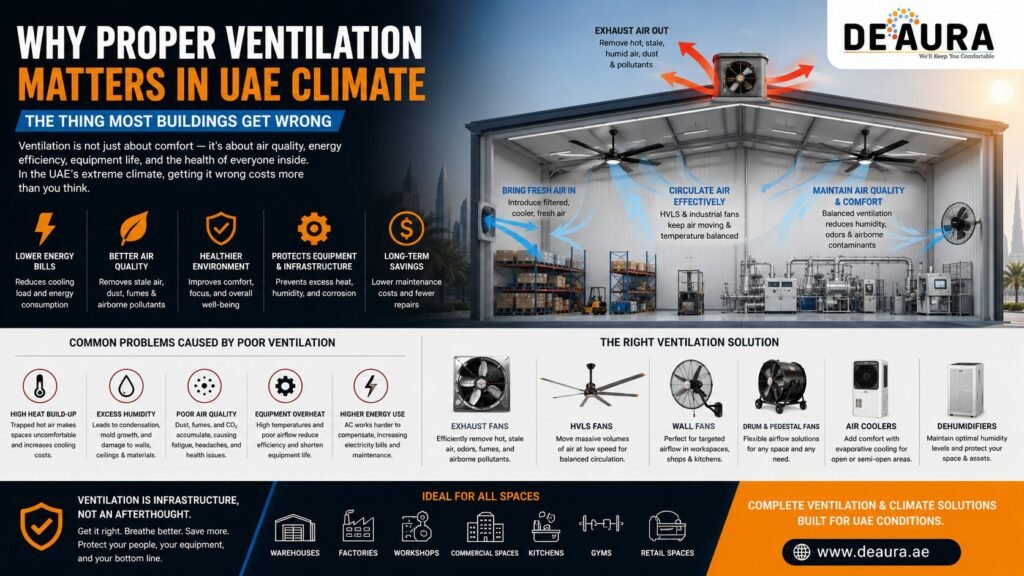
Why Proper Ventilation Matters in UAE Climate — The Thing Most Buildings Get Wrong
Ventilation is not a comfort amenity. In the UAE's extreme climate, it's infrastructure — and neglecting it quietly costs businesses and homeowners more than they realise.
Ask most people what keeps a building comfortable in the UAE and they'll say air conditioning. It's not a wrong answer. But it's an incomplete one — and that gap in understanding is costing businesses and homeowners more than they realise, in electricity bills, in air quality, in equipment wear, and in spaces that never quite feel right no matter how hard the AC runs.
Ventilation is the part of the equation that rarely gets talked about until something goes wrong. And in the UAE's climate specifically — extreme heat, high humidity in coastal areas, significant dust, and buildings sealed tight against the outside air — getting ventilation wrong has consequences that compound quietly over time.
What Ventilation Actually Means — And What It Isn't
There's a common misconception worth clearing up first. Ventilation is not the same as cooling. Air conditioning manages temperature. Ventilation manages air movement, air quality, and the exchange of stale indoor air with fresh outdoor air.
In most climates, buildings naturally breathe — gaps, openings, and pressure differences keep air cycling slowly through spaces without anyone thinking about it. In the UAE, buildings are designed to do the opposite. To keep the brutal outdoor heat out, structures are sealed as tightly as possible. That's the right instinct for energy efficiency, but it creates a different problem: without deliberate ventilation design, the air inside a sealed building gets stale, humid, and increasingly laden with pollutants, CO2, and airborne particles.
The result is a space that feels stuffy regardless of the temperature — where people report fatigue and headaches that seem to have no clear cause, where odours linger, and where surfaces accumulate moisture despite the dry outdoor climate. None of this is fixed by turning the AC colder.
The UAE Climate Makes Ventilation More Critical, Not Less
In temperate climates, a building with mediocre ventilation is uncomfortable. In the UAE, the stakes are higher on every dimension.
- Heat and thermal load. Outdoor temperatures pushing 45°C mean that even small ventilation failures — heat accumulating in ceiling voids, trapped hot air in poorly circulated corners, inadequate exhaust for spaces generating internal heat — create significant thermal problems that force cooling systems to work much harder than they should.
- Dust. The UAE's ambient dust levels are among the highest in the world. Without proper filtration and air management, dust accumulates in HVAC systems, on surfaces, and in the air occupants breathe. Industrial and warehouse environments are particularly affected.
- Humidity. Coastal areas of Dubai and Abu Dhabi experience humidity spikes that can push indoor relative humidity to damaging levels in buildings with inadequate ventilation — degrading materials, promoting mould, and shortening equipment life.
- Air quality. In commercial and industrial environments — workshops, factories, kitchens, paint facilities, warehouses with forklift traffic — airborne contaminants generated internally need somewhere to go. Without proper exhaust ventilation, they stay in the space.
What Happens When Ventilation Is Wrong
The consequences of poor ventilation in UAE buildings tend to show up in four consistent patterns:
The Right Approach to Ventilation in UAE Buildings
Good ventilation in the UAE context isn't about throwing open windows. It's about deliberate, controlled air management that balances fresh air exchange with thermal efficiency. The approach stacks in four layers:
Before anything else, hot air, stale air, fumes, and contaminants need a path out. Exhaust fans positioned at high points — where hot air naturally accumulates — extract from kitchens, bathrooms, workshops, and any heat-generating space. A building that can't exhaust stale air is fighting itself. No amount of supply air fixes it.
Exhaust alone creates negative pressure that pulls in unfiltered outside air through gaps. Balanced ventilation — supply air coming in through controlled, filtered points while exhaust leaves — gives you control over what enters the building and where. This is how you get clean, conditioned fresh air rather than hot dusty air through cracks.
Once air is being properly exchanged, internal circulation determines whether it reaches everywhere it should. Dead zones — corners, high-ceiling spaces, areas behind racking in warehouses — accumulate heat and stale air even in well-ventilated buildings if circulation is poor. HVLS fans, ceiling fans, and strategically placed drum or pedestal fans keep air moving through the entire volume of a space, preventing stratification and hot spots.
In coastal UAE locations and during high-humidity months, mechanical dehumidification in sealed spaces completes the picture. Dehumidifiers working alongside proper ventilation and cooling keep indoor relative humidity at levels that are comfortable for occupants and safe for equipment and materials.
Ventilation as Preventive Infrastructure
The framing that changes how businesses approach this is simple: ventilation is not a comfort amenity. It is infrastructure — in the same category as the electrical system or the plumbing. Neglecting it has consequences that compound over time and eventually become expensive to reverse.
In the UAE specifically, where buildings are sealed against extreme external conditions and where the internal environment is entirely dependent on mechanical systems to stay liveable and productive, ventilation deserves the same deliberate attention as cooling capacity. The two are inseparable.
Getting it right means investing in the right exhaust fans, ensuring adequate internal air circulation through appropriate industrial fans and HVLS systems, managing humidity where necessary, and treating ventilation as a designed system rather than an afterthought.
DEAURA's range — exhaust fans, industrial fans, HVLS fans, air coolers, and dehumidifiers — covers the full toolkit for proper ventilation and climate management in UAE commercial and residential environments. The equipment exists. The question is whether the building it goes into is being treated as a system or just a collection of rooms with AC units.
Cooling Gets the Attention. Ventilation Does the Work.
In a climate as extreme as the UAE's, the gap between a well-ventilated building and a poorly ventilated one is not a minor comfort difference. It shows up in electricity bills, in equipment lifespan, in the health and productivity of the people inside, and in the long-term condition of the building itself.
Cooling gets the attention. Ventilation does the work that makes cooling effective in the first place.
Treat it accordingly.
Talk to DEAURA About Your Building