


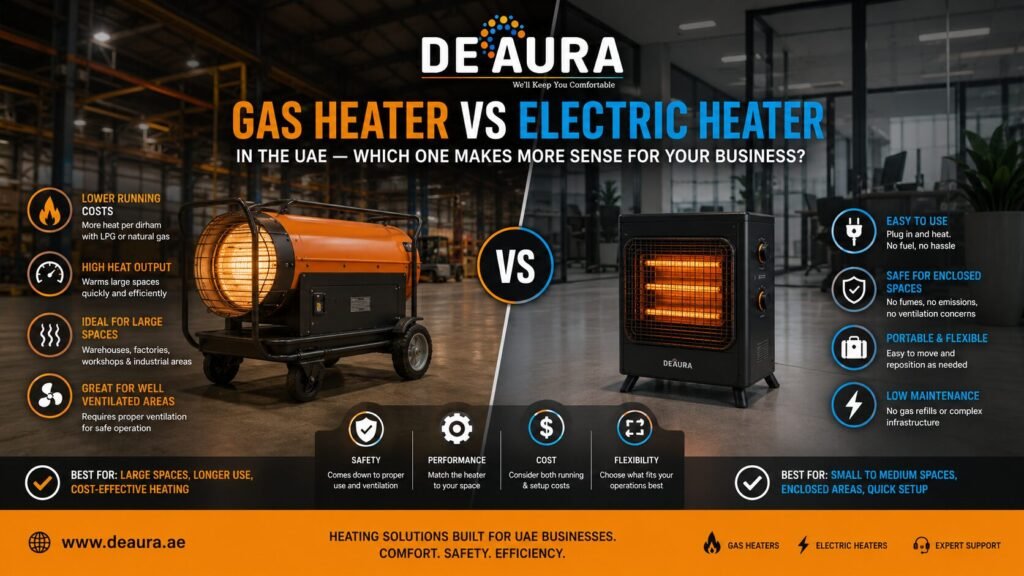
Gas Heater vs Electric Heater in the UAE — Which One Makes More Sense for Your Business?
An honest, scenario-by-scenario breakdown for commercial spaces — warehouses, offices, factories and worksites — through the UAE winter.
Most conversations about climate control in the UAE start and end with cooling. Understandably so. But anyone who's spent a December or January night in Dubai, Abu Dhabi, or the northern emirates knows the temperature drops sharply once the sun goes down — and in industrial or warehouse environments with high ceilings and poor insulation, it can get genuinely cold inside.
Heating is a real operational requirement for UAE businesses, just a seasonal and often overlooked one. And when businesses do start looking at heating solutions, they run into the same question: gas or electric?
Both work. Both have a place. But they're not interchangeable, and picking the wrong one for your setup will cost you — either upfront, on your monthly bills, or in operational headaches. Here's the honest breakdown.
High thermal output, fast response, lower fuel cost per unit of heat. Built for large warehouses and factory floors with proper ventilation.
Zero combustion, zero ventilation needs, plug-and-use. Ideal for sealed offices, retail spaces and small workspaces.
How Each One Actually Works
Before getting into costs and use cases, it helps to understand what you're actually dealing with.
Gas heaters burn LPG or natural gas to generate heat. The combustion process produces heat almost immediately, and because gas burns hot, these units can warm large spaces quickly. The heat output is high, the response time is fast, and the fuel cost per unit of heat generated is generally lower than electricity — especially in commercial quantities.
Electric heaters convert electrical energy directly into heat, either through resistance coils, infrared elements, or ceramic heating technology. There's no combustion, no fuel supply to manage, and no emissions inside the space. Plug in, switch on, heat starts. Simple.
The difference in how they generate heat shapes almost every other practical consideration that follows.
Running Costs: The Number That Actually Matters
In the UAE, electricity costs follow DEWA's tiered pricing structure. For commercial consumers, electricity is not cheap — and it gets more expensive as consumption climbs. An electric heater running at 2 kilowatts for 8 hours a day across a cold season will show up clearly on your bill.
Gas, particularly LPG which is widely available and competitively priced across the UAE, offers a lower cost per unit of heat in most commercial scenarios. For businesses that need to heat large spaces — warehouses, factories, workshops, large retail areas — gas heaters deliver more heat per dirham spent on fuel.
That said, electric heaters have zero infrastructure cost. You don't need a gas connection, LPG cylinders managed and replenished, or any kind of gas supply logistics. If you're heating a small office, a reception area, or a compact workspace for short periods, the simplicity of electric often outweighs the fuel cost difference.
Honest summary on costs: For large spaces and extended heating periods, gas heaters win on running costs. For small spaces and intermittent use, electric heaters are competitive once you factor in the absence of infrastructure overhead.
Safety — The Conversation Nobody Wants to Skip
Gas heaters in enclosed spaces require proper ventilation. This is non-negotiable. LPG combustion consumes oxygen and produces carbon monoxide as a byproduct — in a well-ventilated space, this is managed safely and within standards. In a poorly ventilated or sealed space, it becomes a serious hazard.
For warehouses, workshops, construction sites, and any space with natural airflow or dedicated exhaust ventilation, gas heaters are safe and widely used. For sealed office environments, server rooms, or any space where you cannot guarantee adequate ventilation, electric heaters eliminate this concern entirely.
Electric heaters produce no combustion byproducts. There are no fumes, no carbon monoxide risk, and no ventilation requirements beyond normal room airflow. For enclosed commercial spaces where sealing the building is part of how you keep it warm, electric is the straightforward safe choice.
This isn't a reason to avoid gas heaters — it's a reason to match the heater type to the environment it's going into.
Installation and Setup
Electric heaters win this round decisively. Most commercial electric heaters are plug-and-use. No gas line, no cylinder management, no installation contractor, no compliance inspection before you can turn it on. For businesses that need heating quickly — a new site, a temporary workspace, an event setup — electric heaters are operational in minutes.
Gas heaters require either a piped gas connection or LPG cylinder supply. The cylinders themselves need storage, handling, and regular replenishment. For a permanent facility with a dedicated maintenance team, this is manageable routine. For a temporary site or a business without gas infrastructure already in place, the setup overhead is real.
Performance in Large and Open Spaces
This is where gas heaters pull ahead clearly. A high-output gas heater can produce heat volumes that would require multiple electric units to match — and at lower fuel cost. For UAE businesses operating in large covered spaces that lose heat quickly due to ceiling height, loading bay doors, or frequent foot traffic in and out, gas heaters provide the raw thermal output needed to make a meaningful difference.
Industrial gas heaters designed for commercial use can heat spaces that electric heaters simply cannot service economically. If you're managing a warehouse in Jebel Ali or a factory floor in one of Dubai's industrial zones and need practical heating through the winter months, gas is the realistic solution at scale. Pairing gas heaters with HVLS fans running in reverse circulation pushes warm air down from the ceiling level where it accumulates — significantly improving heating efficiency in high-bay spaces.
Portability and Flexibility
Modern commercial electric heaters are often compact and portable — easy to move between rooms, reposition based on where staff are working, or pack up and redeploy on a different site. For businesses with varied or shifting layouts, this flexibility has genuine value.
Portable gas heaters exist too, and LPG-cylinder-powered units offer reasonable mobility. But they carry the cylinder with them, which adds weight, handling requirements, and the need to monitor fuel levels. Electric wins on pure portability convenience. For businesses that also need cooling solutions for the summer months, the rental option across both heaters and coolers is worth exploring — it avoids capital outlay on seasonal equipment entirely.
Which One Is Right for Your Business?
There's no universal answer, but the decision tree is fairly clear:
- Heating a large warehouse, factory floor, or workshop and cost efficiency at scale matters — gas heater.
- Heating a sealed office, retail space, or enclosed area where ventilation is limited and simplicity is a priority — electric heater.
- Portable heating for a construction site, outdoor event, or temporary workspace — electric for convenience, gas if output requirement is high.
- Mixed facility — office block attached to a warehouse, for example — run both, matched to each zone. Browse the full DEAURA heaters range to compare options across both types.
The UAE Winter Is Short But Real
Businesses that ignore heating until the cold hits end up making rushed decisions and paying more for equipment sourced at short notice. The UAE winter window runs roughly from November through February, and while it's mild by global standards, it's cold enough to affect worker comfort, slow down operations, and in some industries, affect the product or process itself.
DEAURA supplies both gas heaters and electric heaters built for commercial and industrial applications across the UAE — equipment designed to handle the demands of real business environments, not residential use cases dressed up in commercial packaging.
Getting the right heater for the right space before the temperature drops is one of those operational decisions that costs very little to get right and more than expected to get wrong.
Speak to DEAURA About Winter Heating